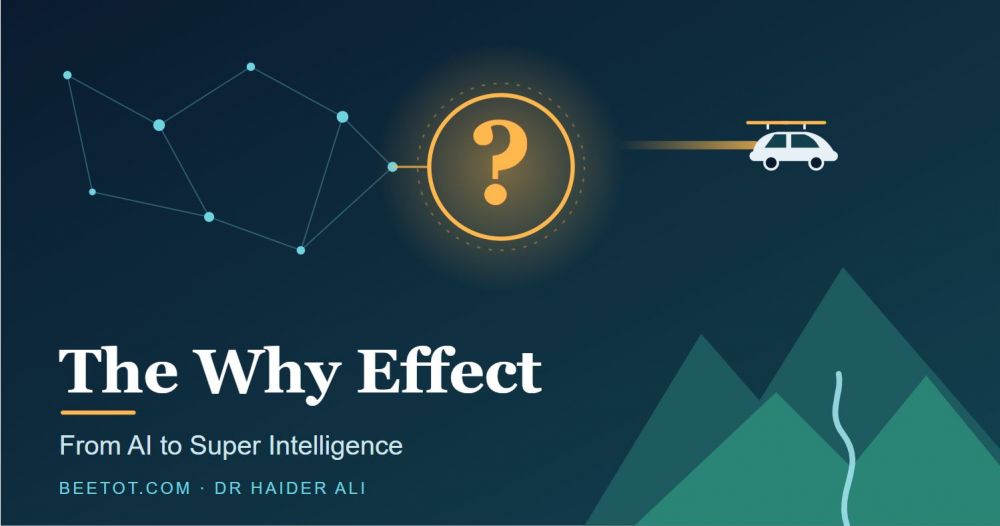
My six-year-old, lying in bed, asked me, "Baba (Father in Pashto), is there a car that can transform into a robot and also fly?”
He asked because he loves cars, and I guess every child loves a fantasy creature. He had no idea how many questions that one question set off in me. I lay awake long after he was asleep, turning it over as a scientist, an engineer, and a teacher.
These days you can talk to your toaster. I think that within ten years a robot will be serving at our kitchen tables. Things that needed a specialist not long ago now take nothing more than speaking, in your own language.
I have been teaching for over twenty years. I started as a private tutor for students from schools around the world, college up to PhD level, and since 2017 I have been an Assistant Professor at UET Jalozai. The tools have changed many times in those years, but this time feels different to me. AI-driven design, IoT machines, digital twins, and new materials that need nano-scale precision are all arriving in mechanical engineering together. In class I keep coming back to one question: what are we preparing our students for?
I don’t see this as a threat. The engineers who do well won’t be the ones racing AI. They will be the ones who understand it, question it, and put it to work for people.
This is the idea I keep returning to.
AI is very good at finding patterns. Give it a million sensor readings and it will tell you what is happening. It cannot tell you why, and the why is what turns a pattern into knowledge. I call this the Why Effect. I believe an AI that can explain itself is one we can trust, and that explaining is the step that could take it further.
Take a digital twin of a turbine that flags a vibration. The model sees the signal. An engineer has to ask whether it is a worn bearing, a misaligned shaft, or a bad sensor, because each one needs a different fix. Now think about how much data connected machines produce every day. Without people who understand the physics behind the numbers, all of it is just noise.
This is where I believe artificial intelligence becomes something more. A pattern in the data is only a claim until it has been checked against what we know to be true, and for an engineer that means first principles. So our job is not only to check the machine’s answers afterward. We have to design intelligent systems that follow first principles from the start, systems that test every data point against them, corroborate it, and link it back to the physics. An engineer makes sure things are as they ought to be, and that nothing the machine concludes breaks a law of physics. A system built that way is no longer just finding patterns. It is choosing its next best step within the bounds of physics, and I believe that is the road from artificial intelligence to super intelligence. The Why Effect is how we walk it.
So engineers have to stand between what the machine says and what is actually true. The tools will keep getting smarter. Someone still has to keep asking why.
I want my students to become leaders, though not in the sense of a title. A leader is the person in the room who can explain what a design does, why it was made that way, and what it costs.
That person looks at a problem from several sides. Will it work, can it be made, will it last? How does the part behave inside a connected machine or a whole factory? What do the numbers really say, and where might the model be confidently wrong? Who is affected, what could go wrong, and just because we can build it, should we?
Ethics matters more as machines become more autonomous. If an algorithm proposes a design, a human still answers for what happens. A flying car with brilliant aerodynamics that is unsafe over a crowded city has failed in judgment, not in physics.
I want my students to be as comfortable with thermodynamics as with Python, and as comfortable with a sensor as with a stakeholder.
A good engineer knows the building blocks, a bearing, a sensor, a control algorithm, a material, and also knows how they fit together so that the whole is both optimized and credible. Those are not the same thing. Optimized means it performs well for its purpose. Credible means we can trust it, because it has been validated and its trade-offs are understood. You can have one without the other: a brilliant design nobody can verify, or a well-tested design that wastes half its potential.
Think of an electric vehicle. A lighter structure extends range but changes the ride and the crash behavior. A stronger motor accelerates faster but heats the battery. A smarter controller recovers energy but relies on sensors that have to last for years. Perfect each part on its own and you can still end up with a poor vehicle. Asking why about one component gives a local answer. Asking it about the whole system shows how a single decision spreads.
These are the engineers who will have to carry the burden of the Why Effect, so that technology supports Nature and never threatens it.
They think across fields and don’t stop at the edge of mechanics, electronics, or computing, because the problems ahead don’t respect those edges. They also borrow from nature. Engineers reshaped the nose of Japan’s Shinkansen bullet train after the beak of the kingfisher and cut the noise it made. It is a good reminder that evolution has been running design experiments far longer than we have.
I have a small example of this in my own life. Since I was a child I have looked at the mountains across from our home in Damorai, Shangla, and wondered what could change life for the people who grew up there, who were not as lucky as I was. Their children have little chance of honest work, and many end up in coal mines, one of the most dangerous jobs there is.
So I did what I now ask my students to do and looked at what was already there. There was cold stream water, so I started a trout farm. Then I saw that the region’s indigenous chicken had been replaced by the broiler, so I added a business breeding the indigenous bird. Both exist because of the mountain rather than in spite of it, and for the people around us they are a ray of hope. That is what I think engineering should be: find what Nature has given a place in abundance and build something that grows with it. Profit and preservation together.
Dr Abdulaziz Irfan Mufti taught us strength of materials, and one thing he said has stayed with me. When an engineer sees something broken, he told us, their eyes should go looking for what caused it. A cracked shaft, a bent beam, a snapped bolt each has a story and a cause inside it. I think the same habit works on Nature. A bird’s beak, a termite mound, the veins of a leaf are designs that have already survived.
What do these engineers need? I see four things.
Simulation and AI, used with understanding. AI is moving from generating designs to predicting how they will behave. Our students will build digital twins fed by real-time data for thermal-fluid systems, manufacturing lines, even energy plants, and they will simulate hardware and software together, since a machine today is mechanics and embedded intelligence in one. The tool predicts. The engineer asks why and decides whether to trust it.
Systems thinking across disciplines. A change in battery chemistry or a new robotic assembly line doesn’t stay in the lab. It reaches cities, supply chains, and energy grids. Engineers need to see that reach and weigh human factors, aesthetics, and ethics along with performance. People live with the consequences of our designs.
Hands-on making. At Georgia Tech’s Woodruff School I was a Teaching Assistant, and some of what I learned there I learned standing in a lab rather than a lecture hall. I watched a strobe light freeze a spinning flywheel so its RPM could be read with nothing but light and timing. I stood inside an acoustics chamber where the walls, roof, and floor had each been designed for a purpose, and for the first time in my life I really understood what silence is. However digital our work gets, nothing replaces building the thing, or standing inside it, and watching it behave. And as people and machines work side by side, engineers will need to understand automation, cyber-physical safety, and collaborative robotics.
Clean energy and resilience. Power is the biggest demand on our infrastructure, and climate is the biggest threat to our future. Engineers need to be ready to work on energy storage, efficient transport, and resilient grids, so that progress doesn’t come at Nature’s expense.
The machines are listening, and they will answer almost anything we ask. They can’t yet tell us whether we are asking the right question.
To my students: learn your fundamentals deeply, build things with your hands, and keep asking why. To my fellow educators: let us teach across boundaries and make ethics and Nature part of the lesson rather than an elective. To industry: make room for engineers who question the output instead of simply delivering it.
Somewhere in my house a six-year-old is still dreaming of a car that flies. Whether that car is safe, and whether it respects the sky and the people below it, will depend on the engineers we train today.
I have worked in classrooms, on a mountain stream, and in startups, HimmelTech with my colleagues at UET and Beetot among them, and I keep arriving at the same belief. Machines alone will not build the future, and neither will engineers who only operate them. It will be built by people who look at the world through an engineer’s eyes, see what others miss, and use that to keep technology in service of people and in harmony with Nature.
Dr Haider Ali holds a PhD in Mechanical Engineering from the University of Sheffield and an MS from the Woodruff School at Georgia Tech. He is an Assistant Professor at UET Jalozai Campus and founder of Beetot Ltd (www.beetot.com).